How to Budget Your Blocked Account Money Like a Berlin Pro
You've done the hard part. You opened your blocked account through Expatrio, deposited the required amount, got your visa, landed in Berlin, and activated your account. Now every month, €992 gets released into your account, and it has to cover everything: your room, your groceries, your U-Bahn rides, your Netflix, your late-night kebab. This guide shows you exactly how to do it.
If you've been googling "how much does it cost to live in Berlin as a student" or "can I survive in Germany on my blocked account money" - you're in the right place. The short answer: yes, you can. But it takes a plan. Let's build one.
What the Blocked Account Actually Gives You Each Month
Germany's blocked account (Sperrkonto) system is designed to release exactly enough money for you to live on while studying. As of 2025 and into 2026, the standard monthly disbursement through Expatrio is €992. This is set by the German government as the minimum required to cover student living expenses for the year.
Here's the important mindset shift: this isn't "spending money." It's your total monthly income while you study. Every euro needs a job. Think of it as a salary - and budget accordingly.
Where Your €992 Should Go
Below is a realistic monthly budget for an international student in Berlin. We've given you a lean scenario (making it work on exactly your disbursement) and a comfortable scenario (if you supplement with part-time work or extra savings).
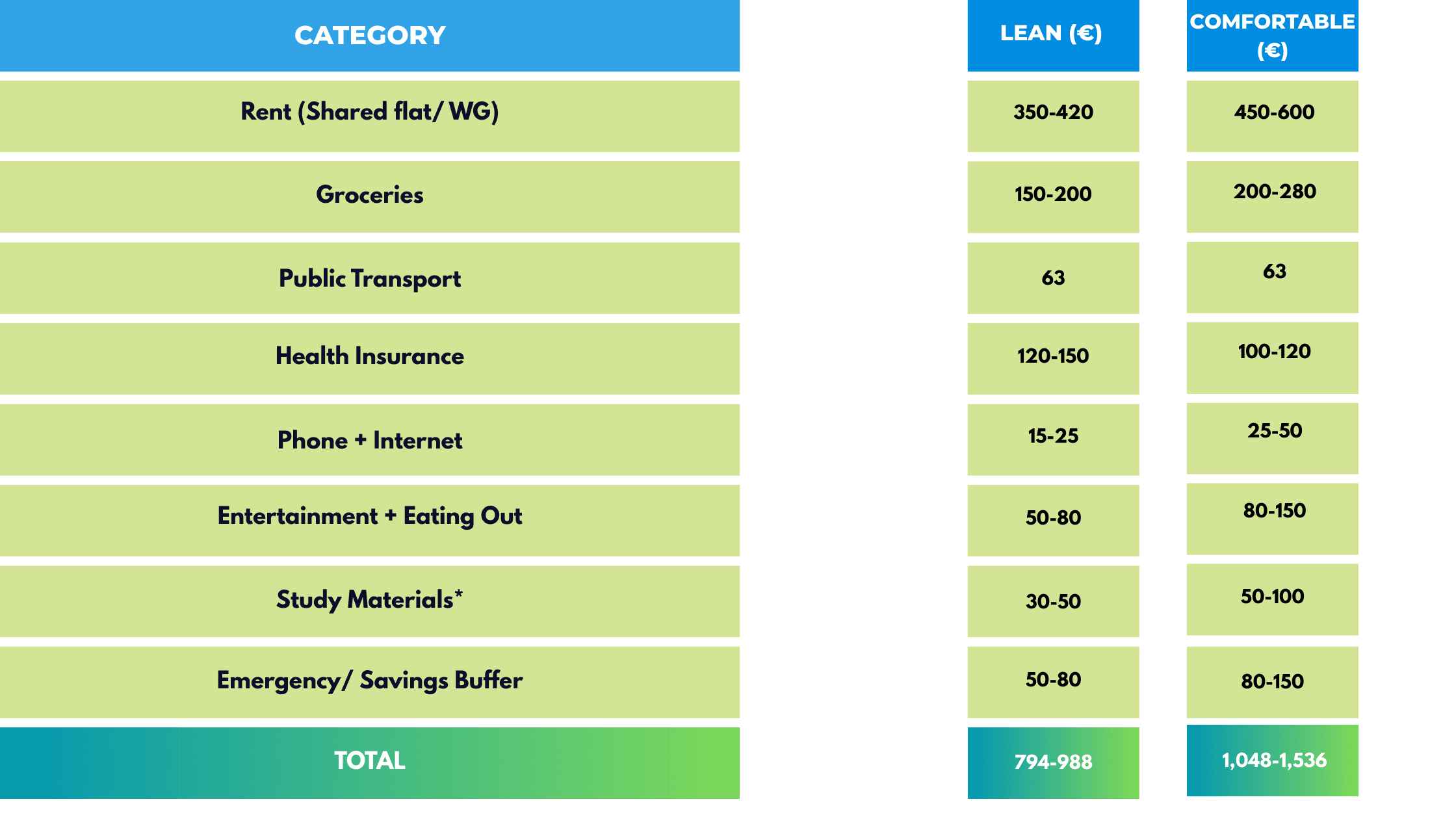
As you can see, living on exactly €992 is possible in Berlin, but it requires affordable housing as your anchor. That single line item determines whether your budget floats or sinks.
The Rent Reality: How to Find a Place Under €450
Accommodation is where budgets are won or lost. Berlin has three main options for international students, and each has a different price tag and availability challenge.
1. Student Dormitory (Studentenwohnheim)
The most affordable option, with rooms running €200–€400 per month. These are managed by Studentenwerk Berlin and are genuinely great value. The catch: apply immediately after admission. Waiting lists are long, and securing a spot can take months. Put your application in the day you receive your Steinbeis offer letter.
2. Shared Flat (WG — Wohngemeinschaft)
This is how most international students in Berlin live, and it works brilliantly. A room in a shared flat typically runs €350–€500 per month, often with bills included. Use platforms like WG-Gesucht.de, Studenten-WG.de, and Facebook groups for Steinbeis or Berlin international students. Be ready to move fast — good rooms go within hours.
3. Private Apartment
We'll be direct: on a €992 budget, a private apartment is not feasible in most of Berlin. Expect €700–€1,200+ for a one-bedroom. Save this option for after graduation.
Watch Out for "Warmmiete" vs "Kaltmiete"
Cold rent (Kaltmiete) doesn't include utilities, you'll pay €100–€250 extra per month for heating, electricity and water. Warm rent (Warmmiete) includes most utilities. When comparing flats, always compare total all-in costs, not just the listed rent.
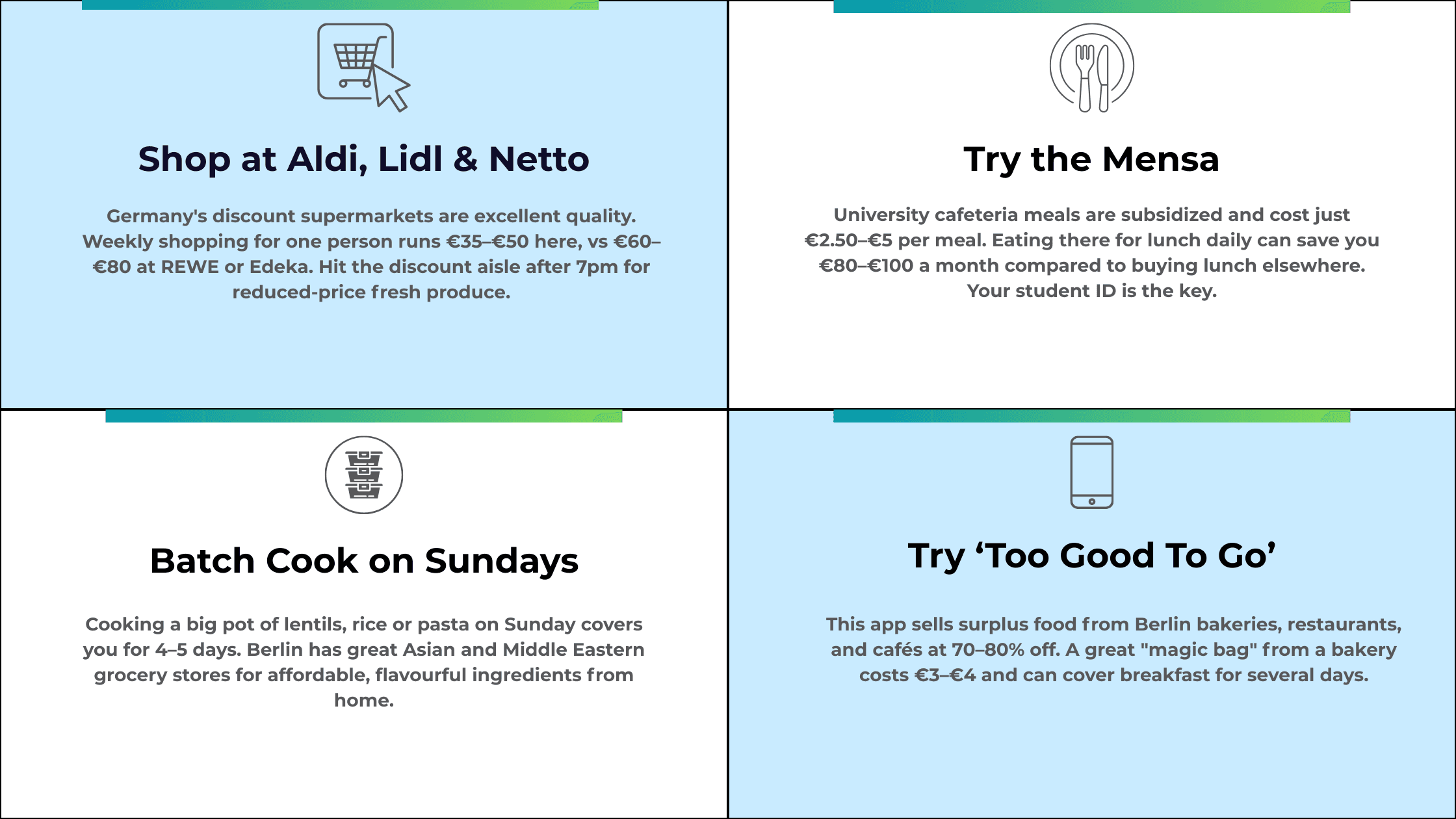
Feeding Yourself on €150–€200 a Month in Berlin
Berlin is genuinely one of Europe's most food-friendly cities for students. Here's your game plan:
Berlin Transport on a Budget
Getting around Berlin is one area where students genuinely save money compared to other European capitals.
The Deutschlandticket
For €63 per month, the Deutschlandticket gives you unlimited travel on all public transport across Germany, not just Berlin. Trams, U-Bahn, S-Bahn, buses, regional trains. For a student who needs to get around the city (and occasionally travel), this is the single best transport purchase you can make.
The Bicycle Option
Berlin is one of Europe's most bike-friendly cities. A second-hand bicycle costs €60–€150 (check eBay Kleinanzeigen), and many students use cycling as their primary transport, cutting transport costs to nearly zero for local trips.
Health Insurance: Budget for It, Every Month
Health insurance is mandatory for all residents in Germany — including international students. Budget €140–€146 per month for public health insurance. Through Steinbeis University's partnership with Expatrio, students have access to streamlined options including Techniker Krankenkasse (TK), Germany's largest public health insurer, at discounted student rates.
This is one budget line you cannot cut. Without valid health insurance, you cannot complete your residence permit registration, and gaps in coverage can create serious administrative headaches. Set it up before you arrive, and treat it as a fixed, non-negotiable monthly cost.
Can You Earn More? Student Jobs in Berlin
International students on a German student visa are legally allowed to work up to 120 full days or 240 half days per year. In practice, this means up to 20 hours per week during the academic semester.
Berlin's working student salary typically starts at Germany's minimum wage (around €12.41/hour as of 2025), and many jobs in hospitality, retail, tutoring, or student services pay €13–€15/hour. Even 10 hours a week at €13/hour adds €520/month to your budget — a significant boost.
Where Steinbeis Students Find Work
Steinbeis University's industry network and the Charlottenburg campus location puts students in the heart of Berlin's business district. Many students find working student positions (Werkstudent) through Steinbeis' company partnerships, LinkedIn, StepStone, and Indeed. These part-time roles are taken seriously by German employers and often lead to post-graduation opportunities.
How Expatrio Supports Your Monthly Budget
As a Steinbeis University student, your blocked account is managed through Expatrio — and the relationship doesn't stop at visa compliance. Expatrio's platform gives you a central view of your monthly disbursement schedule, so you know exactly when money arrives in your account and can plan around it.
Key Expatrio features for budgeting students:
Monthly payout tracking — See your disbursement dates in advance and plan accordingly
Expatrio bank account — Free digital bank account with a debit card ready to use from day one, including Apple Pay and Google Pay
Health insurance integration — Manage your TK insurance alongside your blocked account in one place
Welcome package — Travel insurance coverage for your first days in Germany while you set everything up
Having your disbursement on a predictable monthly schedule is actually a budgeting superpower. Unlike an irregular freelance income, you know exactly when money arrives — which makes planning your rent, groceries, and savings completely straightforward.
You've Got This — Berlin is Affordable if You're Smart About It
Living on €992 a month in a major European capital sounds daunting. But Berlin isn't Paris. It isn't London or Amsterdam. It's a city that was built for people who want to live well without spending a fortune — and international students have been doing exactly that for decades.
The formula is simple: keep rent under €450, shop at the discount supermarkets, eat at the Mensa, get the Deutschlandticket, and build a small emergency buffer. Do those five things and your monthly disbursement from your blocked account covers the essentials with room to actually enjoy one of the world's great cities.